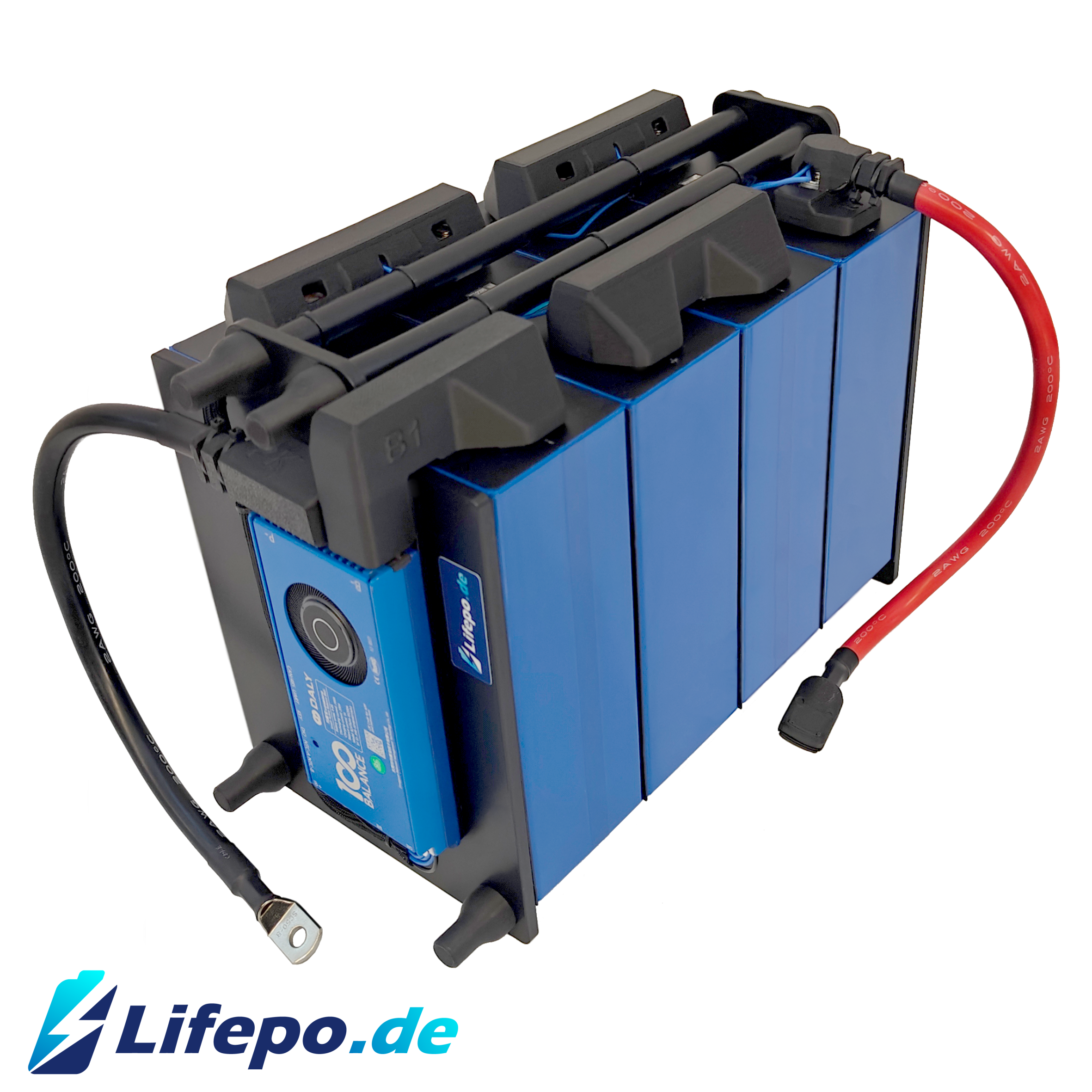


Performance comparison of our battery systems
Depending on the chosen battery system variant, the maximum power output (watts) and the stored energy (watt-hours (Wh) or kilowatt-hours (kWh)) differ.
To better visualize the stored energy of the battery system, here's a brief example: With a 48V battery system with a capacity of 17kWh (17,000Wh), theoretically, 17,000 watts of power can be drawn for one hour until the battery is depleted. This continues analogously; that is, one could also draw 1,700 watts for 10 hours, 170 watts for 100 hours, or 17 watts for 1,000 hours.
Example: An LED lamp with a power consumption of 9W (equivalent to a 60W incandescent bulb) can be operated with a 48V 17kWh battery system (i.e., 17,000Wh) as follows:
17,000Wh/9W = 1,888 hours = 79 days = approx. 2.6 months
The actual battery life can be significantly longer because many devices – such as refrigerators or air conditioners – are not continuously operated at full power. Once the desired temperature is reached, they reduce their power or even switch off temporarily to maintain the temperature. This often extends the effective battery life three to ten times compared to the theoretical lifespan of continuous operation at full power.
The following table shows the runtimes of common appliances with our various battery systems. These runtimes refer to continuous operation of the appliances at full power.
Running times of various consumers with our battery systems
Standard LED lamp (9 watts)
Siemens refrigerator (KG39NXIDR iQ300 191kWh/year)
12V 4.3kWh/333Ah single row
approximately 20 days (478 hours)
approximately 8.2 days (197 hours)
12V 8.5kWh/666Ah single row
approximately 40 days (945 hours)
approximately 16.3 days (390 hours)
12V 8.5kWh/666Ah double row
approximately 40 days (945 hours)
approximately 16.3 days (390 hours)
24V 8.5kWh/333Ah single row
approximately 40 days (945 hours)
approximately 16.3 days (390 hours)
24V 8.5kWh/333Ah double row
approximately 40 days (945 hours)
approximately 16.3 days (390 hours)
24V 17.0kWh/666Ah single row
approximately 79 days (1889 hours)
approximately 32.5 days (780 hours)
24V 17.0kWh/666Ah double row
approximately 79 days (1889 hours)
approximately 32.5 days (780 hours)
48V 17.0kWh/333Ah single row
approximately 79 days (1889 hours)
approximately 32.5 days (780 hours)
48V 17.0kWh/333Ah double row
approximately 79 days (1889 hours)
approximately 32.5 days (780 hours)
HS-24-17.0
approximately 79 days (1889 hours)
approximately 32.5 days (780 hours)
HS-48-17.0
approximately 79 days (1889 hours)
approximately 32.5 days (780 hours)
Sie benötigen weitere Informationen?
- If you make a selection, the page will be completely updated.
Contact and customer support
Products & Technology
Generally
About Us
Payment, shipping & cancellation


